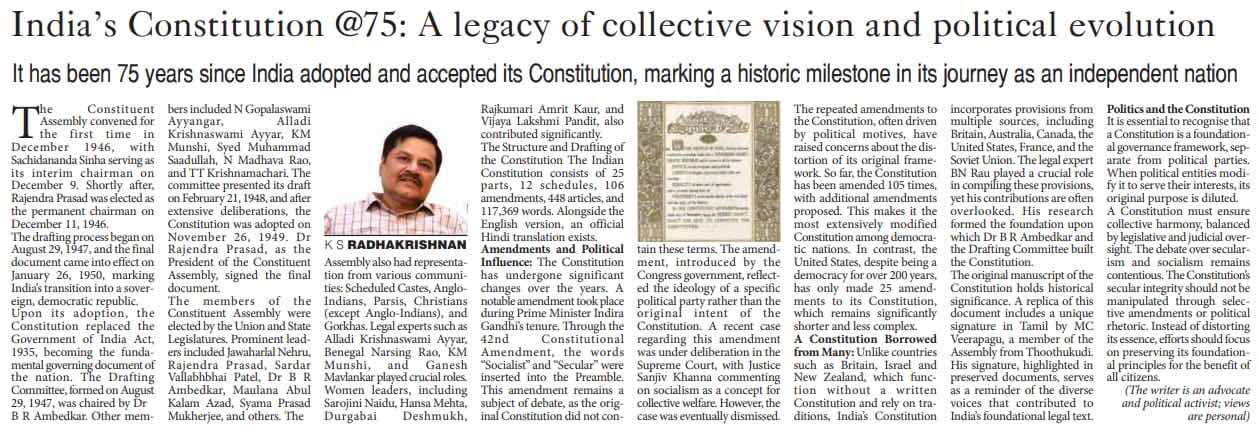
Today’s The Pioneer (7-1-2025) Delhi edition carried my article on the #ConstitutionofIndia-75….
••••
“Indian Constitution 75”
-K.S. Radha Krishnan,
Advocate
It has been 75 years since we adopted and accepted the Constitution of India as our own after achieving independence!
A significant portion of the Indian subcontinent was under British colonial rule from 1858 to 1947. During this period, the Indian independence movement gradually gained momentum to secure freedom from foreign domination. In 1934, the demand for a Constituent Assembly for India was first raised. Subsequently, the demand was reiterated in 1936 and 1939 with increased emphasis. Accordingly, the Cripps Mission in March 1942 recommended the establishment of a Constituent Assembly. Later, the Cabinet Mission in May 1946 also proposed the formation of such an assembly. Following this recommendation, elections for the Constituent Assembly were held in July 1946.
The Constituent Assembly convened in December 1946, with Sachidananda Sinha being elected as its interim chairman on December 9. Subsequently, Rajendra Prasad was elected as the permanent chairman of the assembly on December 11, 1946.
On August 15, 1947, India was partitioned into two nations—the Dominion of India and the Dominion of Pakistan. As a result, the task of drafting the Constitution exclusively for independent India became the responsibility of the Constituent Assembly.
The Constituent Assembly of India was constituted by members elected by the Union and State Legislatures. Eminent leaders such as Jawaharlal Nehru, Rajagopalachari, Rajendra Prasad, Sardar Vallabhbhai Patel, Sandip Kumar Patel, Dr. B.R. Ambedkar, Maulana Abul Kalam Azad, Syama Prasad Mukherjee, Nalini Ranjan Ghosh, and Balwant Singh Mehta were among the key figures in the Assembly. The Assembly included over 30 members from Scheduled Castes. Frank Anthony represented the Anglo-Indian community, while H.P. Modi represented the Parsi community. Arendra Kumar Mukherjee, a distinguished Christian leader, served as the head of the Minority Group and represented all Christians except Anglo-Indians. Hari Bahadur Gurung represented the Gorkha community.
Prominent legal minds such as Alladi Krishnaswami Ayyar, B.R. Ambedkar, Benegal Narsing Rao, K.M. Munshi, and Ganesh Mavlankar also played pivotal roles as members of the Assembly. Women leaders like Sarojini Naidu, Hansa Mehta, Durgabai Deshmukh, Rajkumari Amrit Kaur, and Vijaya Lakshmi Pandit were significant contributors. Dr. Sachidananda Sinha served as the first President of the Constituent Assembly, later succeeded by Rajendra Prasad as the permanent Chairman. The members of the Constituent Assembly convened for the first time on December 9, 1946.
The Constitution comprises 25 parts, 12 schedules, 106 amendments, 448 articles, and 117,369 words. Alongside the English edition, it also includes an official Hindi translation. The task of drafting the Indian Constitution began on August 29, 1947, under the Constituent Assembly of India. The completed Constitution came into effect on January 26, 1950—a date chosen to commemorate the declaration of Purna Swaraj on January 26, 1930. This marked India’s proclamation as a unified, sovereign, and democratic republic under the principles of popular sovereignty.
Upon its implementation, the Indian Constitution replaced the Government of India Act of 1935, which had previously served as the fundamental governing document. From that moment, the Indian Constitution became the foundational document of governance for the nation.
On August 29, 1947, the Constituent Assembly of India passed a historic resolution to draft the Indian Constitution. Pursuant to this resolution, a Drafting Committee comprising seven eminent members was formed, with Dr. B.R. Ambedkar as its chairman. The esteemed members of the Drafting Committee were:
•Dr. B.R. Ambedkar
•N. Gopalaswami Ayyangar
•Alladi Krishnaswami Ayyar
•K.M. Munshi
•Syed Muhammad Saadullah
•N. Madhava Rao
•T.T. Krishnamachari
The Drafting Committee submitted its report on February 21, 1948. The final draft of the Constitution was presented to the Constituent Assembly on November 4, 1948, for deliberation. After meticulous discussions and amendments, the Constitution was adopted on November 26, 1949, with the signature of Dr. Rajendra Prasad, the President of the Constituent Assembly. Subsequently, on January 24, 1950, in the final session of the Constituent Assembly, Dr. Rajendra Prasad was unanimously elected as the first President of independent India.
In subsequent years, the Preamble of the Constitution underwent a notable amendment during the tenure of Prime Minister Indira Gandhi. Through the 42nd Constitutional Amendment, the words “Socialist” and “Secular” were incorporated into the Preamble, reflecting the evolving ideals of the Republic. This amendment stands as a testament to the dynamic nature of the Indian Constitution in addressing the socio-political aspirations of the nation.
Accordingly, the concept of a “secular government” and terms such as secularism or socialism have become incompatible with the original Constitution. This is exactly what I have repeatedly emphasized: the term secularism itself is erroneous. The correct term should be communal harmony. The original Constitution did not contain the words socialist and secular. These were later inserted by the Congress government under Indira Gandhi’s rule.
A related case has been under deliberation in the Supreme Court for the past three days. Justice Sanjiv Khanna, who recently assumed office as the 51st Chief Justice of India, also discussed this matter. Justice Khanna remarked that the term socialism pertains to the welfare of all people. However, yesterday, the case was dismissed.
What we are asserting here is that the fundamental meaning has been altered by the 42nd Amendment, which, as recommended by the Swaran Singh Committee, reflects the ideology of a specific political party. Every ruling party attempts to amend the Constitution to suit its political objectives.
To date, the Indian Constitution has been amended 105 times, with an additional 10 amendments proposed. In terms of its framework, the Indian Constitution is the most extensive among the democratic nations of the world.
However, in the United States, the world’s largest democracy, even after 200 years of independence, their Constitution has permitted no more than 25 amendments. Furthermore, their Constitution has fewer pages and significantly fewer provisions.
In nations like Britain, Israel, and New Zealand, there is no written political Constitution; instead, governance relies on traditions. In contrast, our Constitution incorporates provisions from various countries, including Britain, Australia, Canada, the United States, France, and the Soviet Union. To achieve this, B. N. Rau traveled extensively to the aforementioned nations, compiling and organizing these provisions. Yet, his name is seldom mentioned these days.
Based on his groundwork, the Drafting Committee was constituted under the leadership of Dr. B. R. Ambedkar.
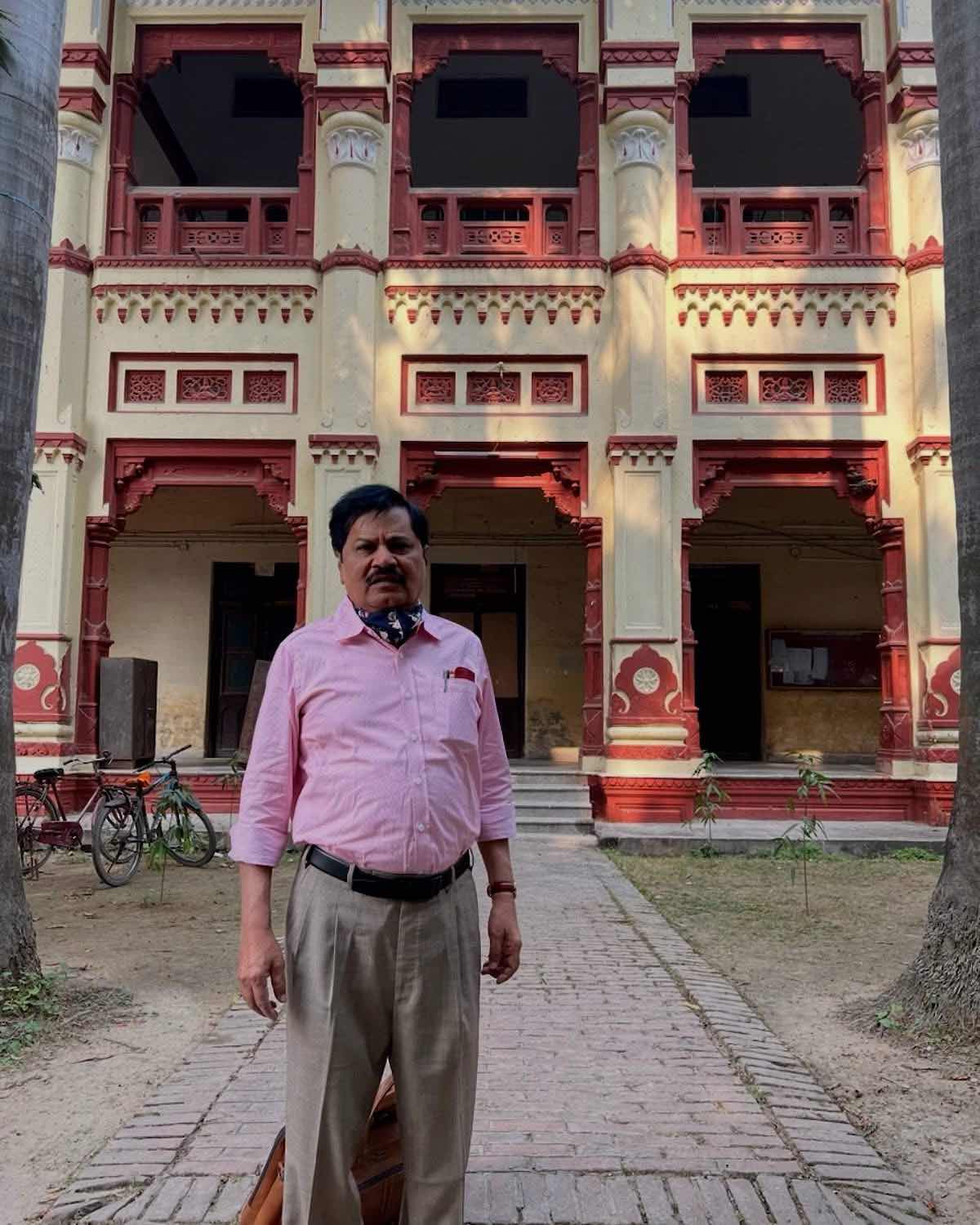
The book I am holding in my hand, as shown in the photograph below, is a replica of the original manuscript of the Constitution.
The final draft of the Constitution, adopted by the Constituent Assembly, bears the unique distinction of having a signature in Tamil. This was by M. C. Veerapagu, a member of the Assembly from Thoothukudi and a close friend of my father. I have highlighted his signature in the accompanying photograph.
It is crucial to understand that the term Constitution pertains to the foundational framework of governance, whereas political parties represent a separate entity altogether. When political parties insert amendments to suit their conveniences, the original intent of the Constitution becomes distorted, and unnecessary interpretations accumulate.
The Constitution is the cornerstone of a nation. It must be regarded as a collective agreement ensuring harmony for all citizens, carefully balanced and structured by both the legislative and judicial branches.
The essence of the Constitution’s secular integrity should not be diluted through divisive terminology or misinterpretations of its original purpose. Instead of being swayed by enticing rhetoric, the focus must remain on measured and effective actions that serve the holistic interests of the nation.
Rahul Gandhi is seen carrying the Eastern Law Publication edition of the Constitution in red binding, speaking about it wherever he goes. But does he know who introduced the 42nd Amendment to the Constitution? Is he aware of the history of this Constitution? Has he read and understood who undermined the very laws of the Constitution? Does he know who stripped the judiciary of its powers during the Emergency through the 42nd Amendment? And who misused these amendments arbitrarily for their own ends?
It was, after all, your ally, the Congress Party, that took education reform laws from the states and placed them under the central government! It was the Congress that moved agriculture into the central list!
With all this in mind, how can Stalin not find it absurd to celebrate the Constitution with your ally, the Congress Party, which made such moves? Isn’t it strange to see those who never respected the Constitution join hands with those who tainted it, claiming to celebrate it together? What meaning does such a celebration hold?
Any protest or political movement must be informed by an understanding of its history—of why and how things unfolded as they did. Yet those who have historically disrespected the Constitution now declare its birth anniversary a cause for celebration. Isn’t that ironic?
- Political activist
#ConstitutionofIndia
#ksrpost
7-2-2025.